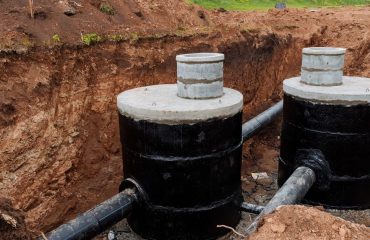
Concrete septic tanks are a long-standing and trusted solution for onsite wastewater management, particularly in rural and semi-rural areas across Australia. When homeowners or developers begin planning a new septic system, one of the most common questions asked is: how much are concrete septic tanks? The answer depends on several variables — tank size, site conditions, and whether you’re factoring supply only or full install septic tank cost. This guide breaks down current concrete septic tanks prices in Australia, compares the cost of new septic tanks across materials, and shows why concrete delivers the lowest lifetime cost despite a higher upfront investment.
Factors Affecting the Cost of Concrete Septic Tanks
Several factors directly influence the price of a concrete septic tank, and understanding these will help you estimate your total project cost more accurately:
- Tank Size and Capacity: Concrete septic tanks come in a range of sizes, typically from 2,000 to 5,000 litres for residential applications. Naturally, larger tanks cost more, both in materials and transport.
- Installation Requirements: The cost of installation can vary depending on access to the site, soil conditions, excavation depth, and labour. A more complex site setup or need for crane assistance will increase costs.
- Delivery and Transport: Due to their weight, concrete tanks require special transport. Delivery distance and whether crane placement is needed can affect final pricing.
- Custom Features: Some projects require dual-chamber designs, inlet and outlet filters, or access risers. Each of these add-ons contributes to the overall cost.
- Council Requirements: Depending on your local council regulations in Queensland, additional fittings or documentation may be needed, which can impact installation and compliance costs.
In general, the supply-only septic tank cost for a standard concrete unit is $2,000–$5,000 in Australia. Once excavation, crane placement, and connections are added, the full install septic tank cost typically lands $5,000–$13,000. How much for septic tank installation on a difficult-access site can push higher — budget an extra $1,500–$3,000 for crane hire, deep excavation, or council-required compliance fittings.
Concrete Septic Tank Prices vs Plastic & Fibreglass at a Glance
Below is a guide to concrete septic tanks prices versus alternative materials, supply-only, for a standard residential 3,000L tank. Full install septic tank cost adds $3,000–$8,000 on top depending on site conditions.
Material → Supply price → Lifespan → Best for • Concrete (precast) → $2,000–$5,000 → 40+ years → Permanent residential, high-water-table sites • Polyethylene (plastic) → $1,200–$2,500 → 15–25 years → Light-duty, easy-access • Fibreglass → $1,400–$3,000 → 20–30 years → Corrosion-prone soils
For a site-specific quote on concrete septic tank cost — including delivery and installation — contact Specialty Precast.
Long-Term Value of Concrete Septic Tanks
While the initial investment in a concrete septic tank might be higher than that of other materials, its long-term value is often significantly better:
- Durability: Concrete tanks can last 40 years or more with proper installation and minimal maintenance, far exceeding the average lifespan of plastic tanks.
- Minimal Maintenance: Concrete’s strength and resistance to environmental factors means fewer repairs or replacements over the tank’s lifespan.
- Environmental Stability: Concrete tanks remain stable underground, resisting floatation, shifting, or collapse in areas with fluctuating water tables or heavy rainfall.
- Higher Capacity Options: Concrete can be poured or precast to meet large capacity requirements, making it suitable for larger homes or commercial projects.
Choosing concrete is not just about initial cost—it’s about investing in a solution that delivers decades of dependable performance with lower lifetime costs.
Frequently Asked Questions
How much does a septic tank cost in Australia?
A standard concrete septic tank costs $2,000–$5,000 supply only, with a fully installed concrete septic system landing $5,000–$13,000 once excavation, delivery, crane placement, and pipework are factored in. Final pricing depends on tank capacity (2,000–5,000L for residential), site access, and council compliance requirements.
How much are septic systems including installation?
A complete residential septic system in Australia — concrete tank, distribution box, absorption trench or evapotranspiration bed, and full install — typically costs $8,000–$18,000. Concrete septic tanks prices sit at the higher end on supply, but lower lifetime cost makes the total system price competitive against polyethylene or fibreglass over a 30+ year horizon.
What is the install septic tank cost on a difficult-access site?
The install septic tank cost rises significantly on tight or sloped sites. A straightforward suburban install might run $3,000–$5,000 in labour and excavation; a rural site requiring long crane reach, rock excavation, or extensive pipework can push installation alone to $6,000–$10,000. We provide an itemised quote covering supply, delivery, crane, excavation, and compliance separately.
How much for septic tank installation on a new build?
How much for septic tank installation on a new build typically ranges $4,000–$8,000 on top of the tank supply cost, assuming reasonable site access. New septic tanks cost more on rural blocks where extended trenching or pump-out arrangements are needed. We coordinate directly with your builder to schedule delivery and install in line with site readiness.