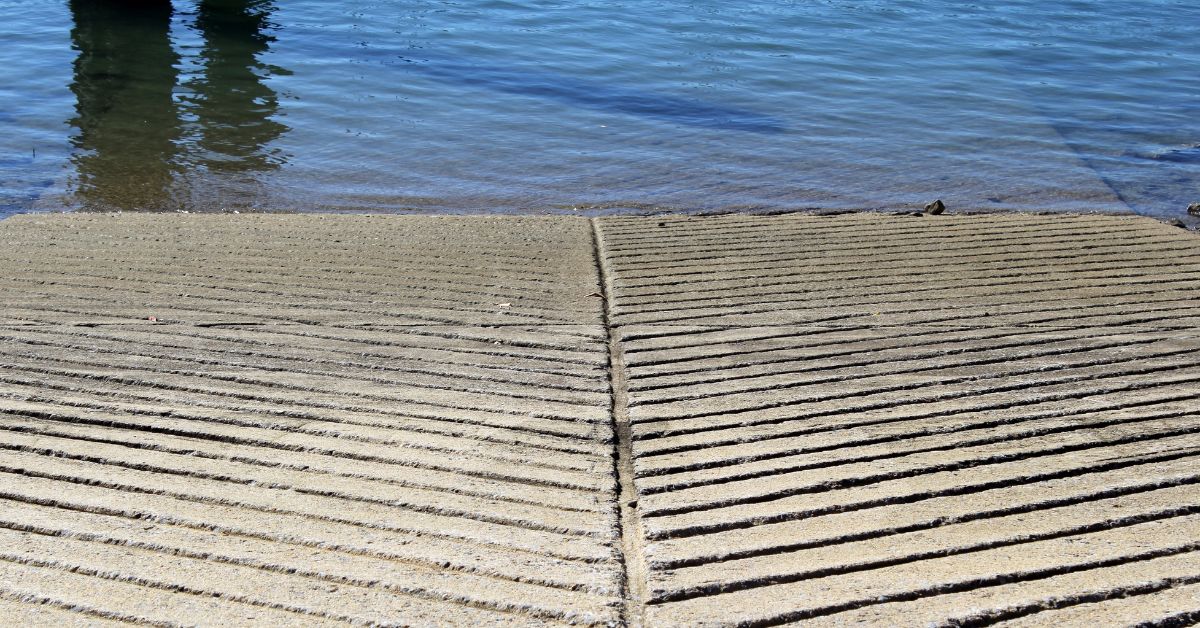
Precast ramp systems can make boat ramp installation faster, safer and more predictable—especially when water levels and weather tighten the work window. The outline below summarises a typical client installation approach to site setup, crane lift sequencing, bedding and jointing, followed by QA checks and handover essentials. Always follow project-specific engineering, drawings and local authority requirements, and engage qualified contractors.
1) Site setup (plan the window, prepare the base)
A good outcome starts before the first truck arrives.
- Survey & set-out: Establish a reliable datum at the ramp crest and tide line, confirm fall direction, and mark plank centrelines, edges and toe position.
- Access & safety: Put traffic and pedestrian controls in place, define exclusion zones for the crane lift, and maintain clear pathways for deliveries and wash-down.
- Environmental controls: Install silt curtains, spill kits and turbidity controls where required. Schedule works around tidal windows to minimise in-water time.
- Subgrade proof-roll: Trim the formation to level and proof-roll. Rectify soft spots with undercut and compacted replacement material.
- Bedding layer: Place the specified bedding—typically a graded granular layer or lean concrete—shaped to the design profile with consistent thickness. Where specified, use a geotextile separator to protect the bedding from fines migration.
- Toe & scour detail: Prepare toe beam or anchor detail to resist downslope movement; stage scour protection (e.g., rip-rap) for immediate placement after the planks go down.
With set-out and base confirmed, lifting can commence.
2) Placement sequence (smooth, repeatable crane work)
Install planks in a controlled sequence that keeps the crane lift efficient and joint lines straight.
- Pre-checks: Each precast plank should arrive with lifting points, identification and orientation marks. Verify tags, inspect jointing arrises, rebates and dowel sleeves, and fit certified lifting clutches.
- First course (control line): Place the top (landward) planks first to lock in line and level at the crest. Use shims or grout pads where allowed to achieve design falls.
- Run down the slope: Working seaward, seat each plank onto the bedding, aligning to the centreline and neighbouring arrises. Temporary spacers help maintain jointing width while levels and falls are checked.
- Dowel alignment / connectors: Where the design includes dowels or shear keys, engage them as each unit lands, confirming full insertion and alignment before releasing the hook.
- Edge restraint: Set edge planks to stringline; if an edge upstand or kerb is specified, engage cast-in fixings or dowels as the sequence progresses.
- Toe connection: Finish at the toe, tying the last plank into the beam or anchor detail and immediately placing scour protection.
- Housekeeping: As each bay closes, clean debris from joints to protect sealant adhesion and prevent point-loading.
This rhythm—lift, seat, align, connect, clean—keeps crane time predictable and ramp geometry true.
3) Jointing & finishing (durability and ride quality)
Once line and levels are signed off, complete the jointing and surface details:
- Sealant or grout: Install the specified joint system—elastic sealant for movement and wash-down resilience, or non-shrink grout where rigid transfer is detailed. Tool neatly and protect from splash until cured.
- Surface texture: Planks typically arrive with an anti-slip finish (e.g., broomed or tined). Keep the surface clean during works so traction matches the design.
- Transitions: Check crest and toe transitions for smooth vehicle launch and retrieval; make local bedding trims if needed to remove steps.
4) QA / testing (measure early, measure often)
Quality is built in, then verified.
- Dimensional checks: Confirm line, level and fall against the design; jointing width and straightness; plank seating and bearing contact.
- Fixings & dowels: Verify engagement depth, location and torque (where bolted). Record heat numbers/batch IDs where required.
- Bedding verification: Spot-check bedding thickness, density and condition at exposed edges or test points.
- Surface & edges: Check arris integrity, anti-slip consistency, and that no chips “steal” joint width.
- Photographic record: Capture before/after of base prep, each crane lift stage, joints, toe detail and scour protection for asset files and future maintenance planning.
Address any non-conformance immediately while access is simple and materials are on hand.
5) Handover (safe to use, easy to maintain)
A clean handover keeps the ramp useful from day one.
- Cure times & opening: Observe cure times for joint systems and confirm when the ramp can take vehicle loads. Keep temporary barriers in place until it’s ready.
- O&M pack: Provide as-built markups, product data sheets, maintenance guidance (wash-down, joint inspection intervals) and contact details for defect periods if applicable.
- Final clean: Leave the ramp and apron free of slurry, grout smears and debris, and confirm clear approaches for trailers.
Why choose precast for boat ramps
Precast reduces in-water work, shortens programs, and delivers consistent geometry across tides and seasons. With factory-made surfaces and integrated features (rebates, dowels, lifting points), boat ramp installation becomes a calm, repeatable process rather than a race against the tide.
Planning a boat ramp installation using precast planks? Specialty Precast can assist with product options, shop-drawing coordination, lifting point details and delivery scheduling to suit tidal windows—so your chosen contractor can complete crane lift, bedding and jointing efficiently.
Get in touch to discuss plank specifications, finishes and logistics for your project.